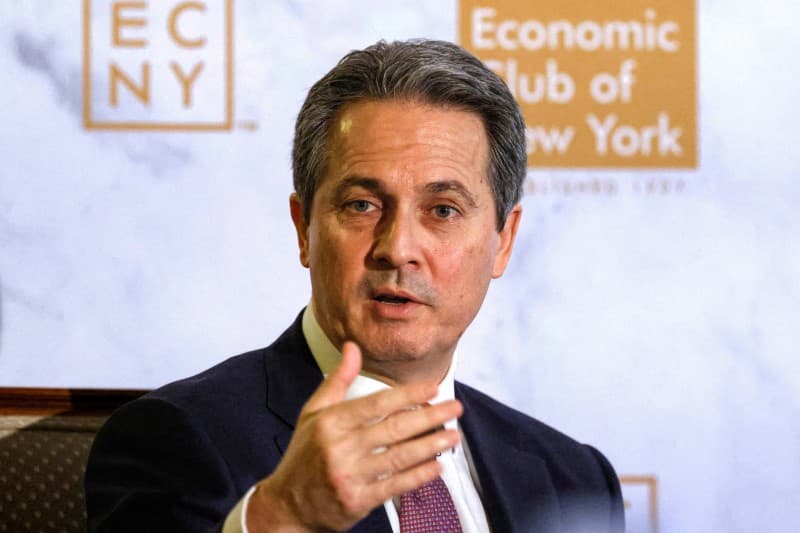
High oil prices will likely keep core inflation nearly a percentage point above the Federal Reserve's 2% target for the rest of this year,
and the U.S. central bank will likely be forced to leave interest rates unchanged, St. Louis Fed President Alberto Musalem said on Wednesday.
"We'll likely see some impact from oil prices on core inflation," with the core price growth rate ending the year "just below 3, maybe around 3," compared to the Fed's 2% target, Musalem told Reuters, noting the risk that the rate could be even higher.
Musalem said the central bank could leave its key rate in the current range of 3.50%-3.75% "for a while" while monitoring inflation, employment, and economic data in the coming months—a view shared by many of his colleagues.
Although the Fed was prepared to cut rates this year, the outbreak of war in the Middle East and the surge in oil prices have changed the outlook, and investors expect the Fed to take an extended pause while monitoring the conflict's impact.
The oil shock, with Brent crude prices still hovering around $95 per barrel compared to around $70 before the US-Israel war with Iran, has quickly impacted gasoline prices, but also promises higher transportation and travel costs, as well as rising food prices as fertilizer and similar inputs become more expensive.
Musalem noted that the news on the price front is not all bad: the impact of last year's tariff hikes is likely to ease in the current quarter, and home price inflation is also declining.
But with oil pushing prices in the opposite direction and inflation across a range of services also high, Musalem said he would be open to raising rates if inflation begins to rise and threatens to push up inflation expectations.
Monetary policy is currently "in a good position, and I think it will probably be appropriate to maintain policy at this level for some time," Musalem said. "We need to see all components of inflation decline in a balanced manner. Right now, housing is doing most of the work. Commodities are moving in the opposite direction, and basic non-housing services are still high."
If the situation worsens, "at that point, the risk of destabilizing inflation expectations will become relevant. Right now, inflation expectations are very stable over the medium and long term, but they will become relevant, and at that point, it may be appropriate to raise rates," he said.
Oil markets are experiencing "the third negative supply shock in 12 months," Musalem said, along with rising tariffs and tightening immigration rules, threatening both the inflation outlook and the labor market due to the likely hit to growth.
Musalem said he believes it's too early to see an impact on overall consumption, although he expects the unemployment rate to rise slightly. He believes growth will be slower this year, though still in the 1.5%-2% range.
"There are two-pronged risks to rates," Musalem said. "Risks have increased on both sides of the mandate—toward higher inflation and toward a weaker labor market... Putting these two things together, policy is well positioned where it currently is."