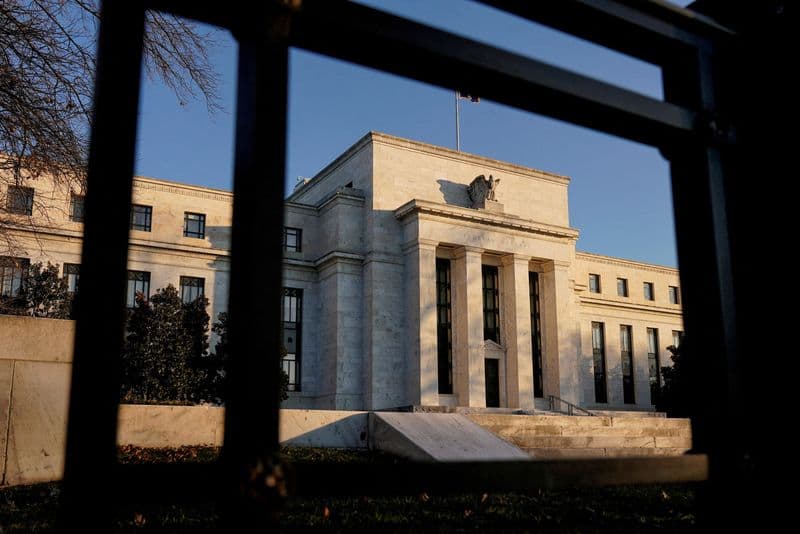
The balance of risks in the Federal Reserve's interest rate policy appears to be shifting toward "higher inflation, rather than lower employment," according to Morgan Stanley analysts.
In a note Friday, strategists including Michael Gapen and Sam Coffin suggested that any sustained decline in inflation going forward depends on the resolution of a joint US-Israeli operation against Iran, especially as upward pressure from the Trump administration's massive tariffs appears to be "nearing a conclusion."
Data this week showed that overall consumer price growth accelerated in May at its fastest pace in years, while higher producer price growth contributed to economists' higher estimates for the Fed's preferred inflation measure, the core personal consumption expenditures price index. These figures were driven by energy prices, which have risen sharply since the outbreak of the war in Iran in late February, largely due to the months-long closure of the Strait of Hormuz, a vital channel for global oil and liquefied natural gas.
Meanwhile, the labor market continued to strengthen despite the conflict, reducing the downside risks to the Fed's policy outlook, Morgan Stanley analysts noted.
Theoretically, raising Fed interest rates could help curb inflation, but could also weigh on the overall economy, including employment.
Markets now expect the Fed to leave rates unchanged at its two-day policy meeting next week, although the central bank intends to raise borrowing costs by the end of the year. At the same time, expectations that the Fed will begin cutting rates in early 2026 have declined.
Underlying these expectations is the belief that the Fed may prioritize fighting inflation, given signs that the US labor market has remained resilient. Morgan Stanley analysts identified "two scenarios under which inflation rises and the Fed either keeps rates at current levels longer or potentially raises them": a "demand stimulus" scenario, in which stronger consumption and corporate investment spur faster growth and a tightening labor market, and a scenario characterized by a persistent oil premium driven by a protracted conflict between the US and Iran.
"Recent events in the Middle East, along with last week's jobs report and this week's inflation data, suggest that both scenarios may be becoming more likely than we initially expected," they wrote. "Overall, the data suggest the balance of risks is shifting toward higher inflation rather than lower employment."
Nevertheless, hopes remain that a peace agreement between the US and Iran may be near.
On Friday, Iranian state media reported that the proposed peace deal between the US and Iran would include Tehran's commitment to reopen the Strait of Hormuz and Washington's promise to lift oil sanctions. Iran's Mehr News Agency stated that the Memorandum of Understanding (MoU) with the US would also include the release of frozen Iranian funds, adding that final talks would focus on nuclear and economic issues. However, discussions of Iran's missile program would be excluded, Mehr reported.
Brent crude futures, the global oil benchmark, fell. On Thursday, the contract fell below $90 per barrel after US President Donald Trump suggested that an agreement to end the war in Iran, now in its fourth month, could be reached as early as this weekend.