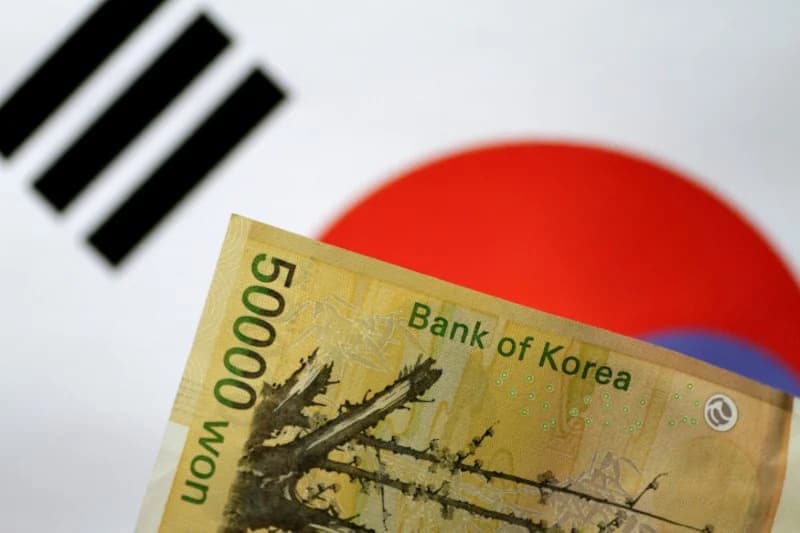
Asian currencies rose slightly on Wednesday, while the US dollar remained near multi-month lows, as falling Treasury yields provided support to regional currencies.
Investors await the release of the minutes of the Federal Reserve's latest meeting.
The USD index fell 0.1% to 99.57 as of 7:39 AM Moscow time, remaining near its lowest since early June.
Treasury Yields Fall; Won Hits One-Year High
The yield on the 10-year US Treasury note fell to 4.702%, while the yield on the 30-year note fell to 5.282%, retreating from recent highs that had been weighing on emerging market assets.
Markets are focused on whether the minutes of the Fed's July meeting will confirm expectations that the Fed may keep rates elevated longer or hike them later this year. The Federal Reserve kept its benchmark interest rate in the 3.50%–3.75% range at its July 29 meeting in a 9-3 vote, with the disagreement highlighting the diverse positions within the Fed.
The dollar came under pressure after softer U.S. inflation data and an unexpected job loss in July dampened expectations for further rate hikes.
The dollar's recent weakness has given Asian currencies some leeway, although gains are constrained by high oil prices and lingering geopolitical risks.
Brent crude remained above $91 per barrel, as uncertainty over Middle Eastern energy supplies continued to fuel inflation concerns.
The USD/JPY pair fell 0.2% to 159.35 yen, but the Japanese yen remains under pressure despite recent efforts by Japanese and U.S. officials to support the currency. The South Korean won led the gains on Wednesday, with the USD/KRW pair falling nearly 1% to its lowest since September 2025.
The Indian rupee weakens for a fifth straight session.
The Chinese yuan (USD/CNY) was unchanged, while the Singapore dollar (USD/SGD) fell 0.1%.
The Australian dollar (AUD/USD) fell 0.3%.
The Indian rupee continued to decline on Wednesday for a fifth straight session. The USD/INR pair last traded up 0.1% at 95.74 rupees.
The currency is under pressure from high oil prices and rising global bond yields, despite reports of likely intervention by the Reserve Bank of India.
"August's performance suggests that markets are becoming increasingly selective in their outlook for Asian currencies. The biggest gains were concentrated in the won and Taiwan dollar, indicating investor preference for currencies sensitive to US rate easing and a robust global technology cycle," MUFG analysts noted in their review.