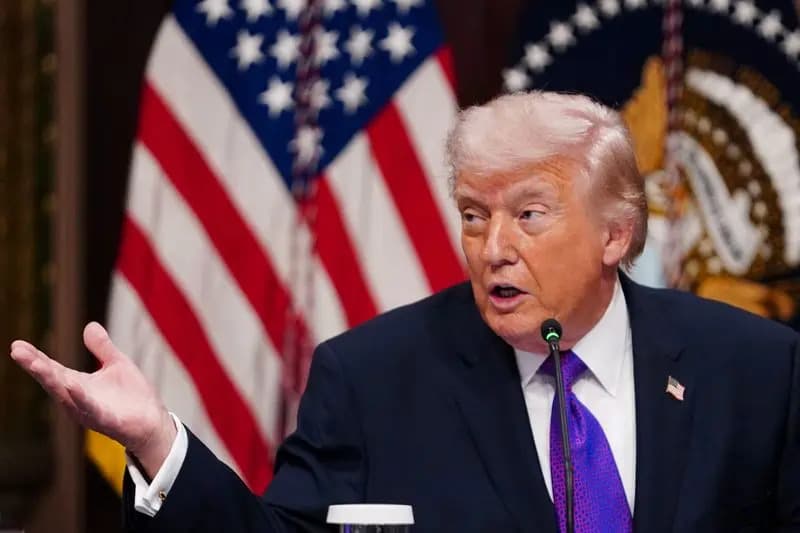
US President Donald Trump gave an extensive interview with CNBC's Joe Kernen in the Oval Office on Thursday, discussing his finances, the economy, and the bills moving through Congress.
Here are five key takeaways.
1. Trump laments the spotlight on his children's investments
The president defended the family business and acknowledged that the presidency creates a conflict of interest in any of his children's investments.
"Whatever they do, the presidency is so powerful... If they buy a cupcake company, the energy to bake them—it's tied to my energy policy," Trump said.
"Almost everything they do... if they buy an energy-efficient truck, it's like they have inside information," he added.
The investments of the president's children are drawing increased scrutiny, especially because their portfolios align with the administration's strategic goals. Authorities have approved deals or contracts with several companies invested in by the younger Trumps, ranging from drone manufacturers to mining projects. Some Democrats in Congress intend to investigate these transactions for insider trading and conflicts of interest.
2. Trump's son Eric manages his finances
After releasing his financial disclosure statement, which showed the president's income exceeding $2 billion through 2025, Trump stated that his son Eric, along with major financial institutions, manages his finances.
"It's being outsourced to large firms... My son Eric does it," Trump said. "I don't discuss things like that with him. I think I'd be allowed to, but I don't."
He said Eric "places funds in semi-blind or blind trusts where other people invest."
The disclosure statement also listed approximately $515 million from the sale of tokens from World Liberty Financial, a company linked to Trump, and $65 million from the sale of a stake in the WLF holding company. Trump called the crypto project legal: "nothing illegal" and "nothing bad."
3. Trump intends to fire Fed member Cook "through a court victory."
Earlier this week, the Supreme Court ruled 5-4 that Trump cannot fire Lisa Cook because her lawsuit is still pending, but left the option open. Trump was unfazed: he declared that he would secure Cook's resignation by "winning the case."
"They remanded the case not on the merits, but on process and procedure," he said.
The president is attempting to fire Cook over alleged mortgage fraud.
4. Trump is reserved on the housing bill and insists on the SAVE Act.
The president gave a tepid response to a question about whether he would sign the bipartisan housing bill passed by Congress last month.
"There are a lot of Democratic provisions in there that I don't even think are good, but whatever," Trump said. "But I've made it clear that I'd prefer not to sign anything until we pass the SAVE America Act."
Trump has been pushing the SAVE Act for months, which would require proof of citizenship for voter registration and could make it more difficult to vote, especially for low-income and minority groups. The president also wants to tie it to a ban on mail-in voting. Its blocking has delayed a housing bill that both parties had hoped would be held up as a model solution to the housing affordability crisis.
The Senate lacks the votes to pass the SAVE Act, and Majority Leader John Thune refuses to lift the 60-vote (filibuster) rule.
"What I really want is for them to lift the filibuster," Trump said.
The housing bill will become law even without the president's signature, unless he vetoes it (which Trump hasn't stated he will).
5. "Our" Judges
Trump lamented that the three liberal Supreme Court justices vote as a bloc, while conservatives often split. "It's very rare that they don't vote as a bloc," he said of the liberals. "And our people, and there are six of them, are a little hesitant."
In his words, "the Republicans want to show everyone that they're not controlled, that they're so noble."
Formally, Supreme Court justices are nonpartisan, although they are appointed with ideological views in mind. Their lifetime appointments shield them from partisan politics, and they often go against the party of the president who appointed them.