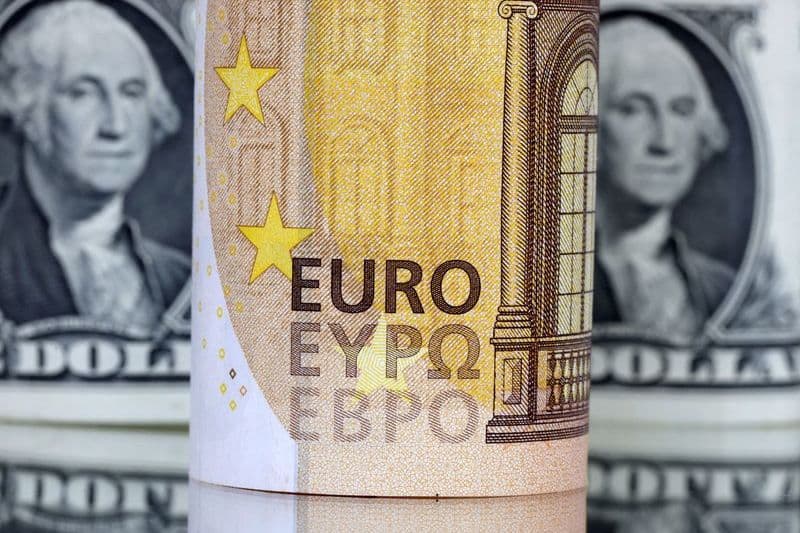
The US dollar was in demand on Tuesday, recovering from the previous session's sell-off amid renewed turbulence surrounding US President Donald Trump's tariff regime.
By 11:55 a.m. Moscow time, the dollar index, which tracks the greenback against a basket of six other currencies, was up 0.1% at 97.765 after falling 0.5% on Monday.
Fresh trade uncertainty
The outlook for the US currency looks uncertain as Trump's new tariff regime takes effect following the Supreme Court's ruling that Trump's use of the 1977 National Emergency Act to impose tariffs exceeded his authority.
Trump said on Saturday that he would raise the temporary tariff from 10% to 15% on US imports from all countries following the Supreme Court's ruling, a move that has left various countries uncertain about the reliability of trade agreements signed before the ruling. The European Parliament decided on Monday to postpone a vote on the European Union's trade deal with the United States due to a new import tax.
Renewed trade uncertainty arises amid growing doubts about the sustainability of massive investments in artificial intelligence, as well as about the underlying strength of the US economy following weak growth data last week.
This session will see the release of ADP employment data and consumer confidence indicators, as well as several Federal Reserve officials speaking, followed by President Trump's State of the Union address.
"The DXY dollar index has twice stopped above 98.00, and we prefer the 97.50-98.00 range," ING analysts wrote in a note.
Euro Stable, ECB Policy in 'Good Position'
In Europe, the EUR/USD pair rose 0.1% to 1.1788, with the single currency trading muted after ECB President Christine Lagarde reiterated her position at a conference in Washington on Monday that the European Central Bank's interest rate policy remains in a "good position."
"At every stage, we must assess whether we are in the good position I'm describing now, which, as a consequence, also means we must be flexible and determine whether we need to do something," she said.
"We don't see much development out of Europe that will move the EUR/USD pair today, and barring another significant decline in global equities, we expect EUR/USD to hold support at 1.1750/60," ING added.
The GBP/USD pair fell 0.1% to 1.3487, with sterling awaiting parliamentary testimony from four Bank of England rate-setters, which could impact sentiment ahead of the Bank of England's next monetary policy meeting in March.
"We know Alan Taylor is a dove who is already voting for a rate cut. We know Hugh Peel is a committed hawk who is likely to continue to oppose Bank of England easing this year. Megan Green has been hawkish and is unlikely to change her stance soon, but the most interesting and likely candidate to reverse the March vote in favor of a rate cut should be Governor Andrew Bailey," ING said.
Yen Has Few Friends
In Asia, the USD/JPY pair rose 1% to 156.12 amid subdued expectations for imminent tightening by the Bank of Japan. The Japanese currency was also under pressure as the country reopened after the holiday, with a Nikkei report claiming that the US authorities took the lead in conducting so-called exchange rate reviews last month to support the Japanese currency.
The USD/CNY pair fell 0.3% to 6.8888 after the People's Bank of China left its one-year and five-year benchmark lending rates unchanged.
The stable policy stance underscored Beijing's preference for moderate support as it balances growth stabilization with financial risk management.
Chinese financial markets reopened on Tuesday after the Lunar New Year holiday.
The AUD/USD pair rose 0.1% to 0.7062, while the NZD/USD pair also added 0.1% to 0.5961.