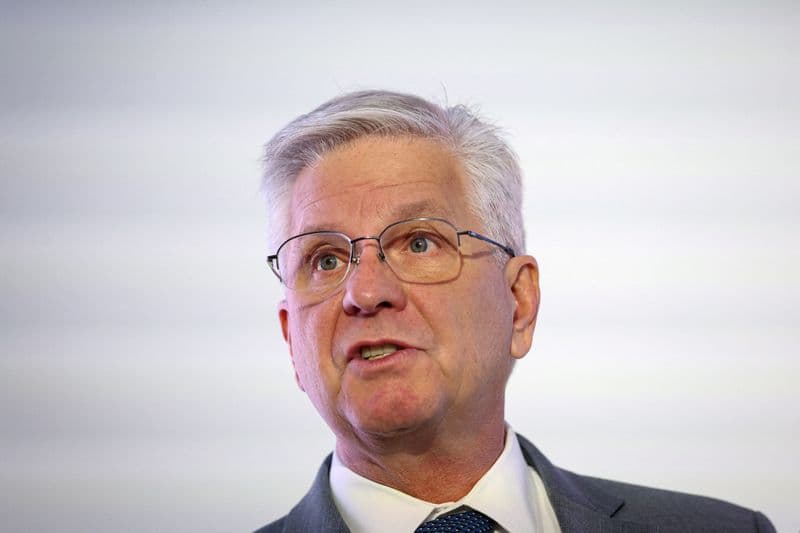
Federal Reserve Board of Governors member Christopher Waller said Friday
that the war in the Middle East will likely lead to higher inflation in the near term and poses a challenging situation for monetary policymakers, although he noted that a quick end to the conflict would leave scope for interest rate cuts later this year.
"The longer energy prices remain elevated and the Strait of Hormuz remains restricted, the more likely it is that higher inflation will become entrenched across a broad range of goods and services, supply chain spillovers will begin to manifest, and real activity and employment will begin to slow," Waller said in a speech he was scheduled to deliver at an event at Auburn University.
If high inflation and weak employment growth become dominant in the economy, "I will have to balance the risks to the two sides of the Fed's dual mandate to determine the appropriate policy stance, and that could mean maintaining the policy rate in the current target range if the risks to inflation outweigh the risks to the labor market," the official said.
He added that if the conflict is resolved quickly, "I see a forecast in which core inflation continues to move toward 2%, which makes me cautious about cutting rates now and more inclined to cut to support the labor market later this year when the outlook becomes more stable."
Waller noted significant uncertainty surrounding the current situation and noted that the Fed is finding it increasingly difficult to ignore what would normally be temporary shocks to the economy. "With a cascade of shocks, policymakers need to be more vigilant," Waller said, adding, "This is because if shocks follow one another, they will keep inflation elevated for quite some time."
In the near term, Waller said he expects the headline personal consumption expenditures price index to reach 3.5% in March, well above the Fed's 2% target. He also noted that changes in the labor market mean the level of job creation needed to maintain a stable unemployment rate is now near zero, meaning job losses in a given month do not necessarily signal a recession.
Waller's remarks are likely to be the last from central bank officials on monetary policy issues, as officials enter a silent period ahead of the Federal Open Market Committee meeting on April 28-29. At that meeting, officials are expected to maintain the current interest rate target range at 3.5% to 3.75%, continuing to seek evidence of how the war in the Middle East is affecting the economy.
On Thursday, New York Federal Reserve Bank President John Williams said he forecasts headline inflation to remain "well above" 3% for several months. Given such uncertainty, "now is not the time to try to provide... clear forward guidance" on the interest rate outlook, he said.
On Friday, Iran declared the Strait of Hormuz "fully open" for transit amid an ongoing ceasefire, even as Trump said the US would maintain a blockade of the country's ports. Oil prices fell and stocks soared, while investors increased the likelihood that the Federal Reserve would lower its interest rate target by the end of the year.