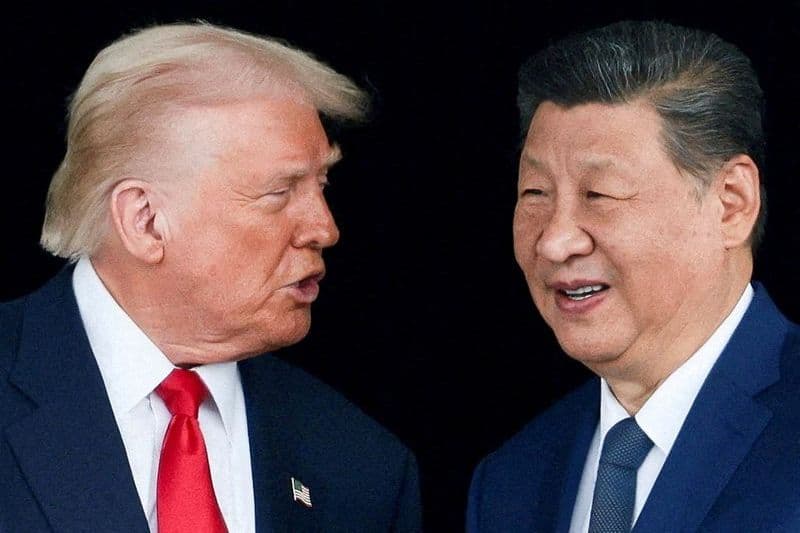
U.S. President Donald Trump held talks with Chinese President Xi Jinping at the White House, followed by a state dinner.
Artificial intelligence was one of the key topics of the meeting. CNBC reports on what is known so far.
Executives from major technology companies attended the dinner, including Nvidia CEO Jensen Huang and his wife Lori Huang, SpaceX CEO Elon Musk, AMD CEO Lisa Su, and Apple CEO Tim Cook. The guest list also included OpenAI CEO Sam Altman and company President Greg Brockman, Google co-founder Sergey Brin, and Microsoft CEO Satya Nadella.
Warnings about the existential risks of AI, which have intensified in recent weeks, have pushed the subject to the top of the global geopolitical agenda.
Before his in-person meeting with Xi, Trump wrote on Truth Social:
"Superintelligence (SI) will be a major topic of discussion, but I want to leave it exactly where it is. That is China's position as well."
The President has recently begun using the term "superintelligence" instead of "AI."
China Promotes AI Cooperation
According to a Chinese report on the meeting, President Xi noted that while China and the U.S. "may have competition, there is even greater potential for cooperation" in the field of AI. "Both sides can continue the dialogue on AI, exchange views on its risks and benefits, and jointly prevent the misuse and abuse of AI," Xi said, according to the report. "AI must remain under human control. A human-centric approach should be upheld, and AI should be developed for the greater good to serve human progress."
According to the Chinese report, Trump stated that both sides should "maintain dialogue and strengthen cooperation in the field of AI." As of publication, the US government had not released its own report on the summit.
These statements follow earlier discussions between US Treasury Secretary Scott Bessent and his Chinese counterpart, He Lifeng, regarding a "US-China dialogue on AI," including a communication channel for incidents "up to the national security level." This has been compared to the Cold War-era "red phone"—a direct line between the US and the USSR designed to prevent the escalation of a nuclear crisis.
At the same time, both administrations have already rejected the idea of restricting or slowing down the development of the technology—measures advocated by Altman and Anthropic’s Dario Amodei, along with a number of researchers from their companies.
Points of contention
More details about the meeting are expected in the coming days, but specifics remain scarce for now. "It seems we have arrived at an intention to continue the dialogue, as well as an agreement on some sort of emergency hotline," Aalok Mehta, Director of the Wadhwani AI Center at the Center for Strategic and International Studies, told CNBC.
Although the Chinese account of the meeting sounds cordial, a number of contentious issues could have made the conversation tense.
U.S. export restrictions preventing China from importing advanced Nvidia chips likely remained a sticking point. At the same time, recent chip and AI model releases by Chinese tech giants are bolstering Beijing’s argument that the effectiveness of these restrictions has limits.
Friction may also have arisen from reports regarding Chinese companies accessing Nvidia chips remotely via overseas data centers, as well as U.S. allegations concerning model "distillation."
Time will tell whether progress was made on these issues. And even if it was, there is no guarantee that either side will disclose specific commitments.
Nevertheless, the continuation of the dialogue could lead to more substantive agreements on AI, Mehta believes.
"The hotline itself could become a reliable tool, provided it is paired with a proper incident reporting system. But that will require genuine commitment and high-level engagement from both sides."