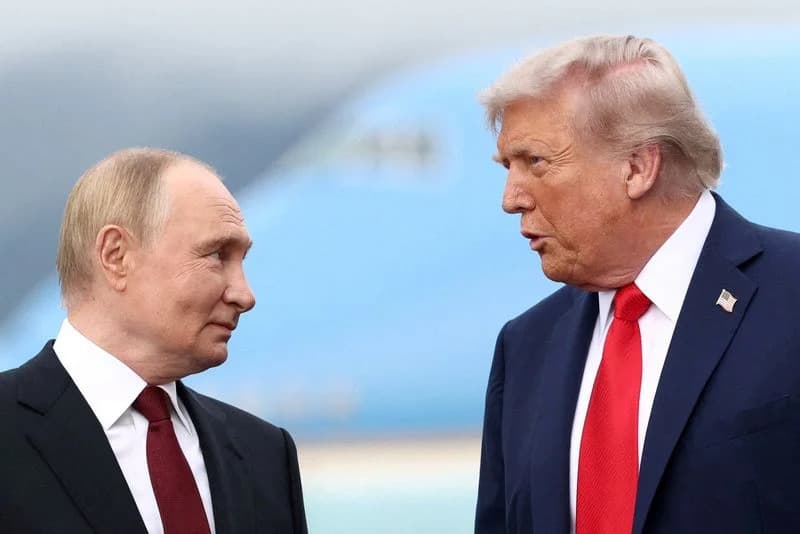
US President Donald Trump has announced an agreement with Vladimir Putin to supply Russian diesel fuel to US and global markets, CNBC reports.
According to Trump, the deal was reached during a phone call with the Russian leader on October 9—a conversation he described as highly successful.
Trump wrote on Truth Social that Russia would immediately supply over 300,000 tons of diesel fuel, followed by another 500,000 tons in November and 1 million tons shortly thereafter. Additionally, depending on the status of Russian refineries, Russia is set to supply another 3 million tons in the near term. Trump stated that diesel prices in the US and worldwide would begin to fall at a record pace. He attributed this to the agreement with Russia and US control over the Strait of Hormuz. For context: at a price of approximately $1,300–$1,500 per ton, 3 million tons of diesel would be worth around $4–$4.5 billion.
At Trump’s direction, the US Treasury Department issued a temporary general license authorizing the supply of Russian diesel fuel to the global market. The license is valid until April 2027. As NPR notes, this is the first license for Russian diesel fuel since the start of the special military operation to remain valid for longer than the standard 30 days.
Russian Deputy Prime Minister Alexander Novak announced that Russia is immediately beginning to lift diesel export restrictions ahead of schedule. According to him, supplies could increase in November and December as refineries complete maintenance, while the domestic market remains fully supplied with diesel fuel. Trump thanked Putin for the decision and stated:
"We need oil for the world. It’s diesel—that’s what we need."
A statement from Putin, released by the Kremlin, noted that Russia had confirmed its readiness to supply oil and petroleum products to US and global markets, and that the arrival of Russian oil on the American market would have a positive impact on the global economy. The leaders agreed to maintain personal contact and cooperation between their administrations, intelligence agencies, and government departments. TASS reports that this was their sixth conversation of the year.
Russian Presidential Aide Yuri Ushakov stated that the conversation lasted an hour and a half and was friendly in tone. Putin and Trump discussed trade cooperation and the situation regarding Ukraine in detail, as well as potential supplies of Russian petroleum products to American and global markets. Putin told Trump that Kyiv's efforts to halt Russian forces were futile and that Russia's position regarding the objectives of the special military operation remained unchanged. Trump congratulated Putin on his birthday. No dates were discussed for a meeting between the leaders, though both intend to attend the APEC summit in China, Ushakov added.
US Special Envoy Steve Witkoff reported that the US had discussed resolving the conflict before winter sets in with representatives from Ukraine, Europe, and NATO. Topics included preparations for the cold season, grain exports, security guarantees for Ukraine, and post-war reconstruction. Participants agreed to continue diplomatic efforts ahead of the next US contact with Russia.
Ukraine will continue striking Russian oil refineries despite Trump’s deal with Putin, the *Financial Times* reports, citing a Ukrainian official. An RBC-Ukraine source had previously stated the same: strikes will continue until an energy truce is reached.
According to Axios, Trump decided to strike a deal with Putin after Zelenskyy ignored about half a dozen US requests to halt strikes on Russian refineries; Washington believes these attacks affect fuel prices in the US. A Ukrainian official told Axios that the US side warned Kyiv that the US might cut off intelligence sharing if the strikes continued. A US representative denied this, stating that Witkoff and Kushner assured the Ukrainian side that the US remains a strong partner, supplying both ammunition and intelligence. Zelenskyy told Axios that the deal caught him off guard, calling it unfair, unjust, and an unwarranted gift to Putin.
Trump also stated that he did not rule out revisiting the plan to avoid launching massive strikes on Iran before the midterm elections: "I could do it. We'll see." On October 8, the US urged Americans to leave Iran immediately.
The market responded with a sharp rally. On Friday, November-delivery diesel futures on the CME exchange fell 4.98% to $4.6396 per gallon. The MOEX Index rose 3.87% to 2,401.8 points by the end of the evening session on October 9, climbing above the 2,400-point mark for the first time since June 30.
Leading the gains were Rosneft (+10.19%), Sovcomflot (+9.07%), LUKOIL (+8.42%), Surgutneftegas (+7.69%), and Tatneft (+6.47%), according to Moscow Exchange data.
The rally continued on Saturday, with the MOEX Blue Chip Index gaining 4.34% to reach 15,947.59 points. On the over-the-counter market, the USDRUB exchange rate is rising by 0.99% to 85.87 rubles, while the euro is up 0.03% to 95.33 rubles.